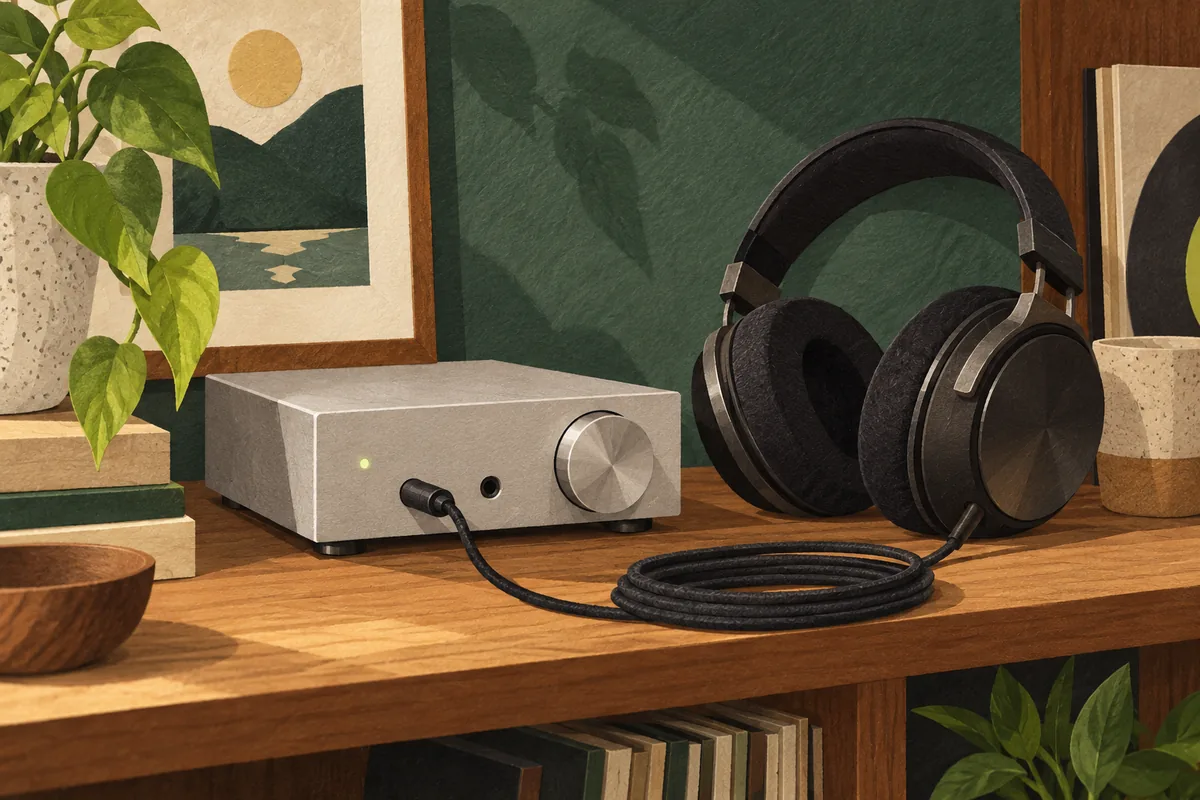
The best headphone amps solve a real problem. They give quiet headphones more room to play. They add a useful volume knob. Some also replace a noisy computer output or let you shape the sound.
I would start with the headphones and the source you already own. If they play cleanly at a comfortable level, an extra headphone amp may add very little. If you do need one, the right connections matter more than a long list of chips.
These five picks are for listening through wired headphones. They cover a desk, a laptop, and a pocket. Each makes sense in a different setup.
The best headphone amps for five common setups
| Headphone amp | Where it fits |
|---|---|
| JDS Labs Atom Amp 2 | An analog source you already like |
| FiiO K7 | A desktop with several digital inputs |
| iFi ZEN DAC 3 | A USB source, with a simple bass control |
| Qudelix-5K | Phone use and detailed sound adjustment |
| Schiit Magni | An analog amp with an optional internal DAC |
1. JDS Labs Atom Amp 2: the straightforward desktop amp
The JDS Labs Atom Amp 2 is my first pick if you already have a good analog source. It is a headphone amplifier, with RCA and 3.5 mm inputs. There is no USB DAC inside.
The front has 6.35 mm and 4.4 mm headphone sockets. Both use a single-ended circuit. The 4.4 mm socket is there for cable fit, not a claim that the amp has a balanced output.
JDS listed it at $129 on September 24, 2026. I like the narrow brief: useful power, a metal case, and direct controls. The main extra cost is a DAC if your source only sends digital audio.
My call: a sensible dedicated amp for an existing desktop system. Skip it if you want to plug a USB cable straight into one box. On the product page, buyers describe using it with high-impedance headphones and praise support. Those reports are useful, but they do not prove that every listener will hear a change.
2. FiiO K7: the DAC amp for a busy desk
The FiiO K7 combines a DAC and headphone amplifier. Its USB, optical, coaxial, and RCA inputs suit a desk with more than one source. The front has a 6.35 mm headphone output and a 4.4 mm balanced output.
FiiO rates the balanced output at at least 2 watts into 32 ohms, with total harmonic distortion plus noise below 1 percent. That is a stated test condition, not a reason to turn the volume up. Power figures only make sense when the load and distortion limits match.
I would choose the K7 for connection choice. Its USB input is USB-B, so a USB-C laptop may need the right cable. It also needs its own power supply.
My call: a practical all-in-one desktop amp. Check the model name: the K7 BT adds Bluetooth. The standard K7 does not. Do not pay for wireless connectivity unless you plan to use it.
3. iFi ZEN DAC 3: simple USB listening, with a bass button
The iFi ZEN DAC 3 is a DAC amp built around a USB-C input. It has 6.35 mm and 4.4 mm headphone outputs, plus line outputs for other audio gear. It can take power over USB.
The front-panel appeal is easy to grasp. PowerMatch changes gain. XBass+ adds a bass lift. I would choose it if I wanted those controls within reach, without opening an app.
Its simple digital input is also a limit. It is less suited to a desk that needs optical or coaxial inputs. Make sure the USB source can supply the power required by your setup; iFi also provides for a separate 5-volt supply.
My call: a tidy headphone amplifier for one USB source. The bass control is a preference, not a repair for every pair of headphones. Start with it off, then decide whether the change helps the music you play.
4. Qudelix-5K: a portable headphone amp with useful EQ
The Qudelix-5K can receive audio by Bluetooth or USB. Its 20-band equalizer lets you adjust parts of the sound, then store the settings on the device. That makes it a more flexible choice than a headphone amp with only a volume control.
The headphone outputs are 3.5 mm single-ended and 2.5 mm balanced. The latter is not the 4.4 mm size found on several desktop amps. Check the headphone cable before adding one to your order.
The listed price was $109 on September 24, 2026, before shipping and any import costs. Qudelix quotes 6 to 20 hours of battery time. The wide range reflects different use, so do not plan a long day around the top number.
My call: the best fit here for music lovers who want portable EQ. The app adds a learning curve, and a rechargeable battery adds one more thing to manage.
5. Schiit Magni: choose the DAC when you buy
The Schiit Magni gives you a choice. Buy it as an analog headphone amp, or add the internal Mesh DAC. The DAC adds USB-C. Check which version is in your cart. Not every Magni takes USB audio.
The base black model was listed at $119 on September 24, 2026. Adding the DAC changes the total. The unit also has preamp outputs for powered speakers.
I like this choice for a fixed desk. You can buy the parts you need in one small box. Read the return terms first. Schiit gives you 15 days to return it, with a 15 percent fee. It also lists a three-year limited warranty.
My call: a good route if you know whether you need a separate DAC. Compare the full configuration price, shipping, and return cost with a ready-made DAC amp before deciding.
Do you need a headphone amplifier at all?
Try the headphones you own with the source you use most. Can they reach a comfortable level without strain or noise? Is there room for a quiet recording as well as a loud one? Can you set the volume in small, useful steps?
If the answer is yes, a new headphone amp may not be the best use of the budget. Better-fitting ear pads, a quieter room, or headphones with a sound you prefer can matter more.
If the answer is no, name the fault. Low volume may call for more power. Hiss may call for a quieter output. A loose jack may call for a repair. A harsh recording will still be harsh through a costly headphone amplifier.
I would avoid buying an amp on a promise of incredible sound alone. Ask what changes in the chain. A dedicated amp is useful when it supplies something the current output cannot.
DAC amp or separate DAC: what is the difference?
A DAC turns digital audio into an analog signal. A headphone amp gives that signal the voltage and current needed to drive headphones. A DAC amp puts both jobs in one case.
Your phone or computer already has some form of digital conversion when it plays sound through an analog jack. An external DAC gives you another way to do that job. It does not make a poor recording become a better recording.
For a laptop with only USB-C, a USB DAC amp is easy to use. Connect it to the laptop. Plug your headphones into the amp. Does your source already have good RCA outputs? An analog headphone amplifier may be all you need.
Modern and vintage gear can share a desk, but their ports differ. A digital optical output cannot plug straight into RCA inputs with a passive cable. You need a device that converts the signal. Check both ends before buying an adapter.
Enough power matters more than the biggest number
Two headphones with the same impedance can need different amounts of power. Impedance is an electrical load, shown in ohms. Sensitivity describes how much sound the headphones make for a given input. Read both when you judge a headphone amp.
High-impedance headphones often need more voltage. Some low-sensitivity designs can need substantial current too. A large watt figure by itself does not tell you how an amp will handle every pair.
Compare power output at the same load. A rating at 32 ohms is not a direct match for a rating at 300 ohms. Also check whether the figure applies to the balanced output or the single-ended headphone output.
The maker's Atom Amp 2 design notes explain its output layout and power choices. I would use that kind of specific information before a claim that a box can drive just about anything.
More available power is room in reserve. It is not a listening target. Keep volume comfortable and take breaks. Do not turn up the amp to try to hear a claimed improvement.
Balanced output: check the circuit and the plug
A balanced headphone output uses a different circuit arrangement from a common single-ended output. On some amps, it offers more power. That does not make it a required upgrade for most headphones.
The plug size alone does not tell you the circuit. The Atom Amp 2's 4.4 mm socket is a useful example: it accepts that cable format while remaining single-ended. The K7's 4.4 mm socket is a balanced output.
Use the cable and wiring the manufacturer supports. Do not attach an unknown adapter that joins the negative output channels of a balanced headphone amplifier. A connector that fits can still be wired the wrong way.
Does your pair have a fixed 3.5 mm cable? A supported 6.35 mm adapter may be all you need for a single-ended jack. A balanced output may need a new headphone cable. First check that your headphones support that wiring. Then ask if you need the extra power.
Desktop amp or portable headphone amps?
A desktop amp gives you a stable place for a volume knob, several inputs, and power from the wall. It can stay connected to speakers and headphones. The cost is space and more cables.
Portable headphone amps trade some of that convenience for size. A battery-powered unit can take work away from a phone, while a small USB-powered DAC amp draws power from the source. Battery life, cable strain, and pocket fit become part of the choice.
I would choose a desktop headphone amplifier for a fixed listening spot. I would choose a portable unit when I need the same wired headphones with a phone and laptop. There is little point buying a large desktop amp for a bag you carry each day.
Keep portable gear in its own pouch. The passport pockets in our travel wallet guide are for documents and cards. A cable and a metal audio box can make that space bulky fast.
Sound quality, EQ, and what an amp can change
A headphone amplifier should have enough power and low enough noise for the headphones you use. Once those needs are met, differences between competent amps may be small. A change in volume can also make a quick comparison seem more dramatic than it is.
EQ changes the balance of bass, mids, and treble. That can make a clear change to a headphone's sound signature. It is a different job from adding clean power.
The Qudelix user guide covers its EQ and output controls. Start with small changes. A large bass boost can reduce the room left for loud peaks, so reduce the level as needed.
When comparing different amps, use the same track and match the listening level as closely as possible. Switch off sound effects you do not mean to compare. Then focus on the problem you wanted to solve, such as hiss or a lack of volume range.
What about a tube headphone amp?
A tube amp can appeal for its design and the way a particular circuit behaves. It may also bring heat, tube replacement costs, and a different output impedance. Those traits need to fit the headphones, not just the room's style.
I would not make a tube headphone amp the default first purchase. The phrase tube warmth is too broad to predict what every tube amp will do. Read the specific design's output limits and headphone guidance.
A solid-state amp is often the simpler first choice. You may still like the look or sound of a tube amp. That is a fair reason to want one. Just check what it will cost to keep it running.
Build quality: the parts you touch each day
The best headphone amplifiers should be easy to live with. Check the volume knob, feet, and headphone jack while you can still return the unit. The knob should move smoothly. The case should stay put when you plug in a cable. Good build quality shows up in these small tasks.
Look at the back as well as the front. Leave space for stiff plugs and power leads. If a desk shelf blocks the analog inputs, a smaller case may be harder to use than a larger one. Stereo outputs for speakers need room too.
Try low gain first. High gain raises the level faster for the same knob movement. It may help with demanding headphones, but it can leave too little volume range for a sensitive pair. High gain is a setting to use when needed, not a sign of better sound quality.
For portable use, add battery life to that check. A rechargeable battery is convenient until it is empty. Check how the unit charges and whether you can use it while it charges. A short top-up should fit your day, rather than become a daily chore.
A new DAC or amp should solve the fault you can name. If sound quality was already good, a better knob or useful ports may be the whole gain. That can still make it a worthwhile purchase at an affordable price.
A clean setup in six steps
- Turn the headphone amp's volume down before connecting headphones.
- Connect the source to the correct input. USB, optical, and RCA serve different roles.
- Choose the matching input on the amp and output device on the computer.
- Start in low gain. Move to higher gain only if you need it.
- Play a familiar track and raise the volume slowly.
- Check that speaker outputs are set as intended before switching modes.
A USB-C cable must carry data, not just power. If the DAC does not appear on the computer, try a known data cable and a direct port before blaming the headphone amp.
If you hear hum, check the power and signal path. Unplug one source at a time to find where the noise starts. Avoid stacking hot gear or covering vents. The correct power supply matters more than a tidy-looking cable bundle.
For recording, use the right kind of headphone output
A music DAC amp is rarely the first box a new podcaster needs. An audio interface or recorder can let you hear your mic directly. Your voice does not have to take a trip through the software first. That cuts the delay.
Our podcast equipment guide shows where that headphone output fits. A separate listening amp can be useful elsewhere, but adding it will not fix a noisy mic or a room with too much echo.
For music at a desk, I would buy the Atom Amp 2 if I already had a good analog source. For one box with digital inputs, I would start with the K7. For portable EQ, the Qudelix-5K has the clearest purpose. The best headphone amps earn their place by making your own setup easier to use.